Truths Be Told: Museum of International Folk Art
I’ve been twice now to see the exhibit Truths Be Told: Artists Activate Traditions at Santa Fe’s Museum of International Folk Art (MOIFA). The exhibit features a handful of artists working in craft media traditions such as fabric and ceramics. The artists selected are using their mediums to “confront some of today’s most pressing social, political, economic, and environmental issues,” in the words of the wall text introducing the exhibit. Often they subvert expectation to make an ironic point, or a political or social one. Further panels of wall text explain how the works use tradition to “disrupt complacency”, “bear witness”, “raise voices”, “nurture community”, “resist injustice”, “reclaim cultural heritage” and “reverse erasure”, “map inequities” and “denounce inhumanity.” A tall order for art! Luckily many of these works are also a joy to behold.
California artist Elyse Pignolet reimagines blue and white delftware as a means of pointing out persistent inequality for women. In Remember the Ladies, she inscribes a vase with the words of Abigail Adams to her husband, John Adams, as he helped to draft the Declaration of Independence. The vase is presented in front of a wall covered with delftware-patterned motifs and the words “good girl” and “bad girl.” I admire Pignolet’s clever choice of medium and style to convey the message that full equality for women is as yet incomplete, still constrained by outdated domestic expectations.
Pignolet’s second installation at the exhibit features ceramic dishes and tiles and refers to the “me too” movement. The artist says, “My hope is that something so familiar and beautiful can generate a cognitive shift as it’s viewed over time.” From a distance these works evoke a certain type of interior decor; once you begin to decipher the words and images you see the impact is no longer so cozy.
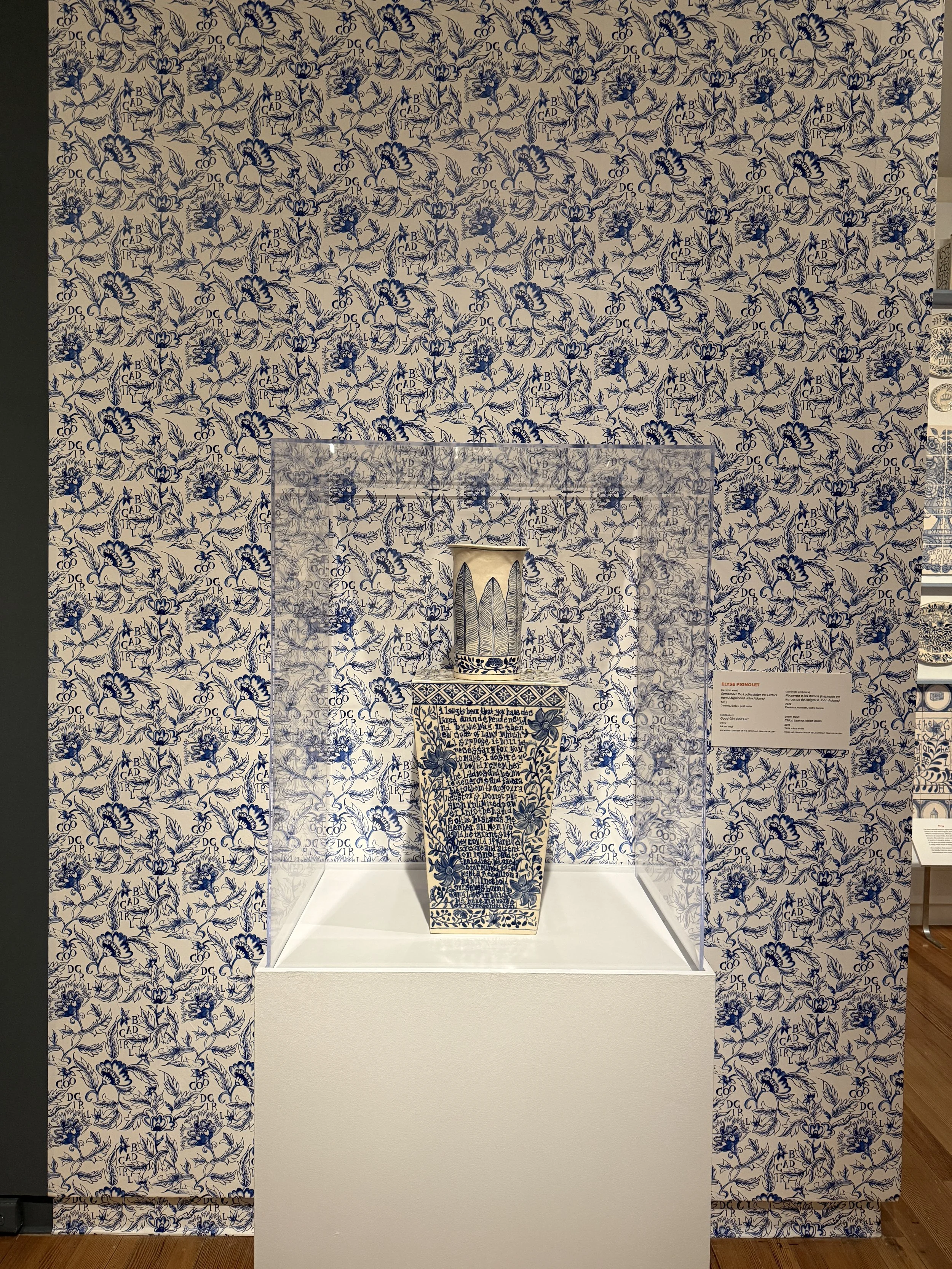
Elyse Pignolet, Remember the Ladies ceramic and Good Girl, Bad Girl vinyl wallpaper.
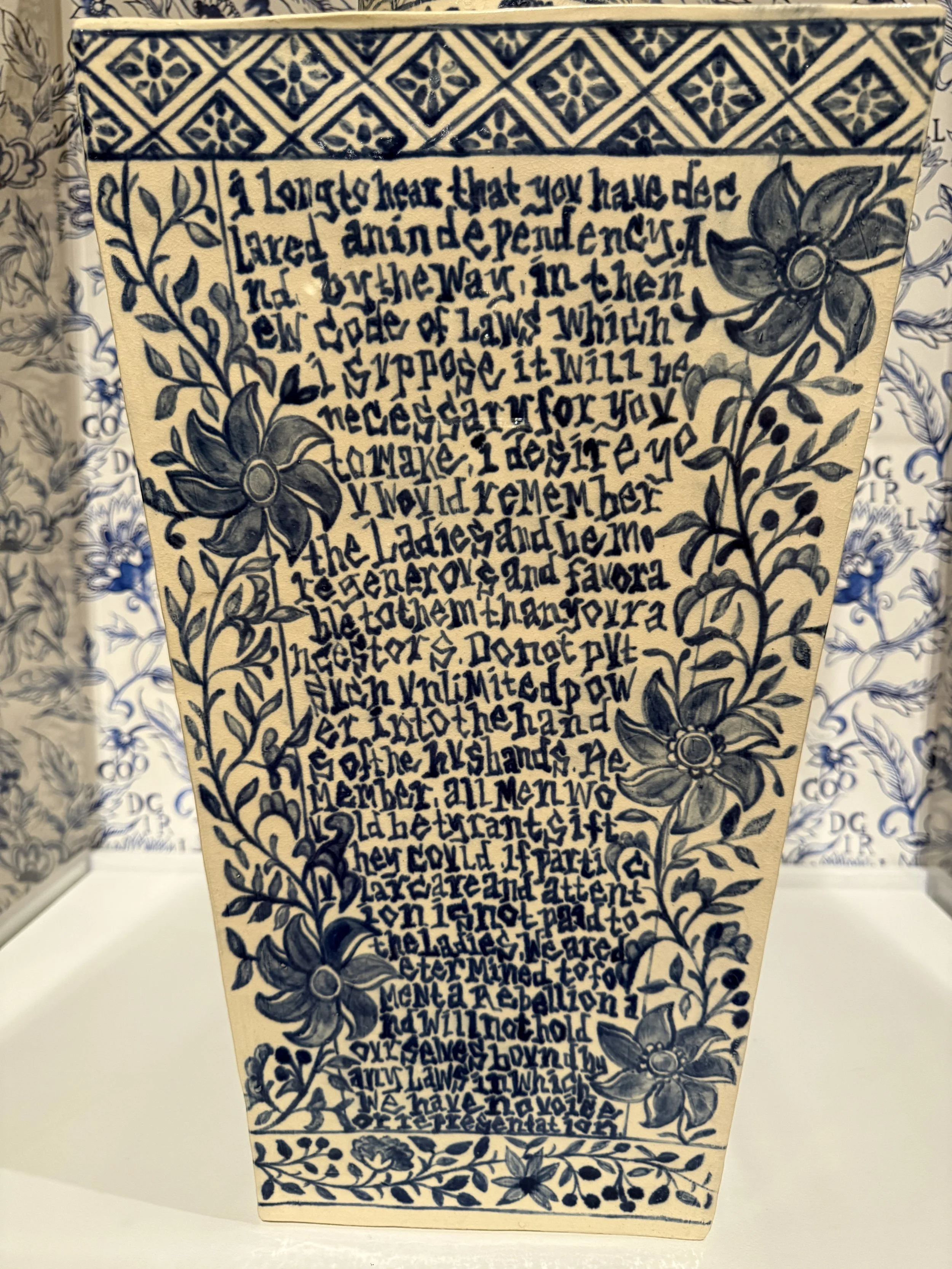
detail, Elyse Pignolet, Remember the Ladies ceramic and Good Girl, Bad Girl vinyl wallpaper.
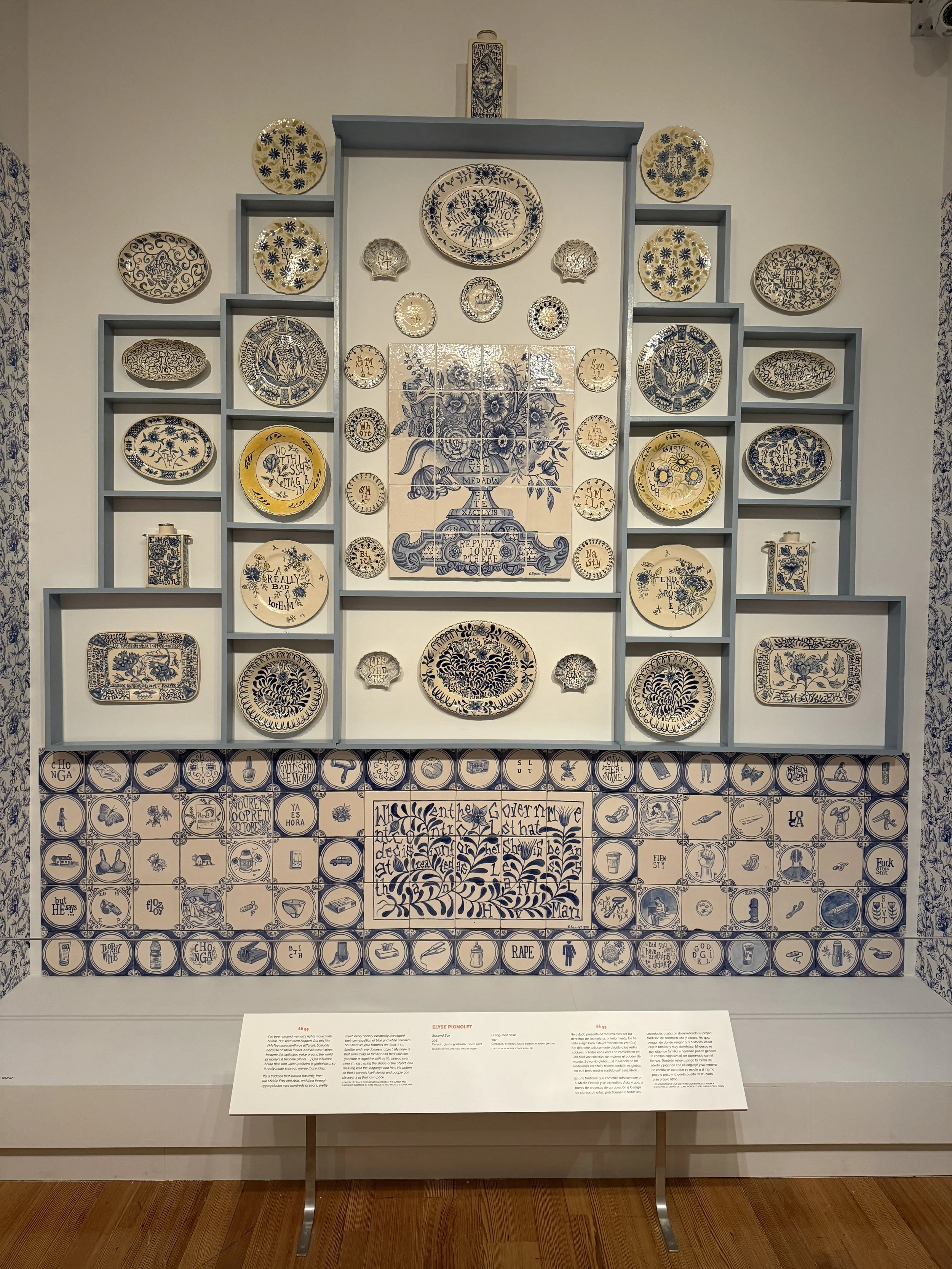
Elyse Pignolet, Second Sex, ceramic, glazes, gold luster, wood, paint.
As an artist who enjoys collage, I especially liked the work of Ambreen Butt. Her layered and stitched collages of paper and painted mylar show the evidence of her training in Indian and Persian miniature painting. Some elements, such as leaping deer and ornate arabesque borders featuring gold leaf, refer directly to that tradition. But viewers who lean in for a closer look see images of violent protests and read tiny strips of text quoting the last words of George Floyd: “Mama” and “I can’t breathe.”
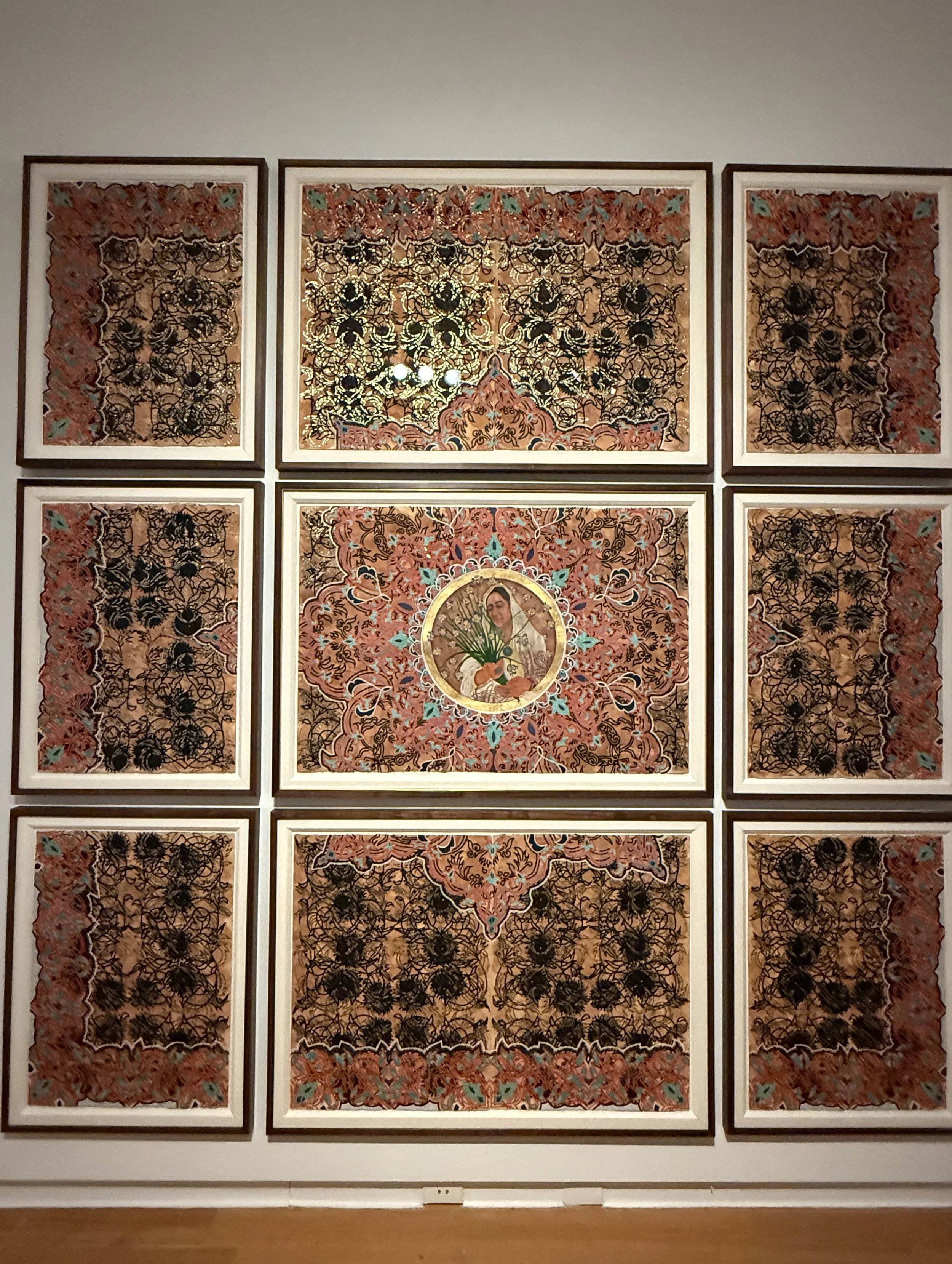
Ambreen Butt, Soul of My Soul, paper, watercolor, gouache, gold leaf.
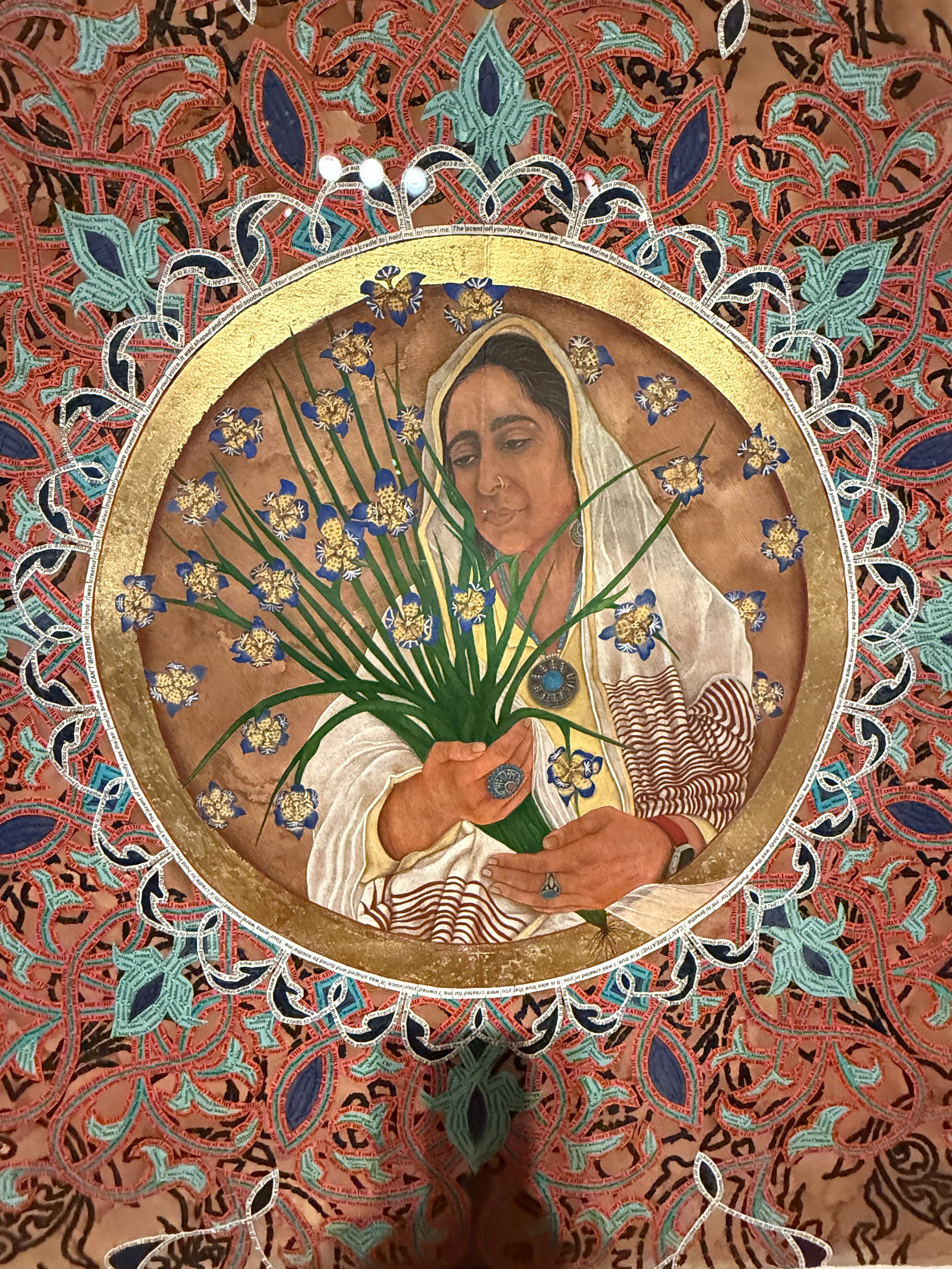
detail, Ambreen Butt, Soul of My Soul, paper, watercolor, gouache, gold leaf.
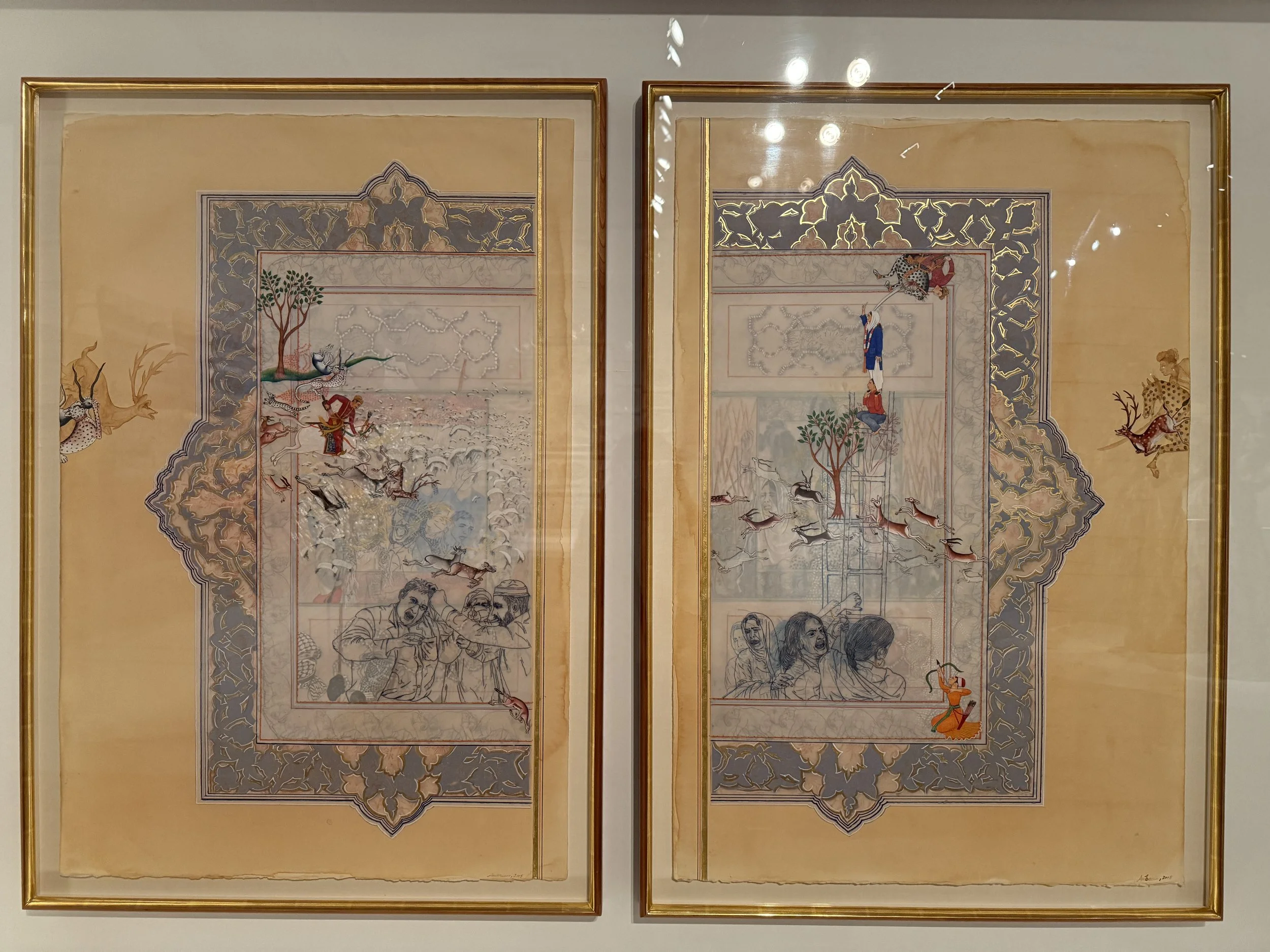
Ambreen Butt, The Great Hunt from the series Dirty Pretty. Water-based pigments, whie gouche, thread and gold leaf on layers of mylar and tea-stained paper.
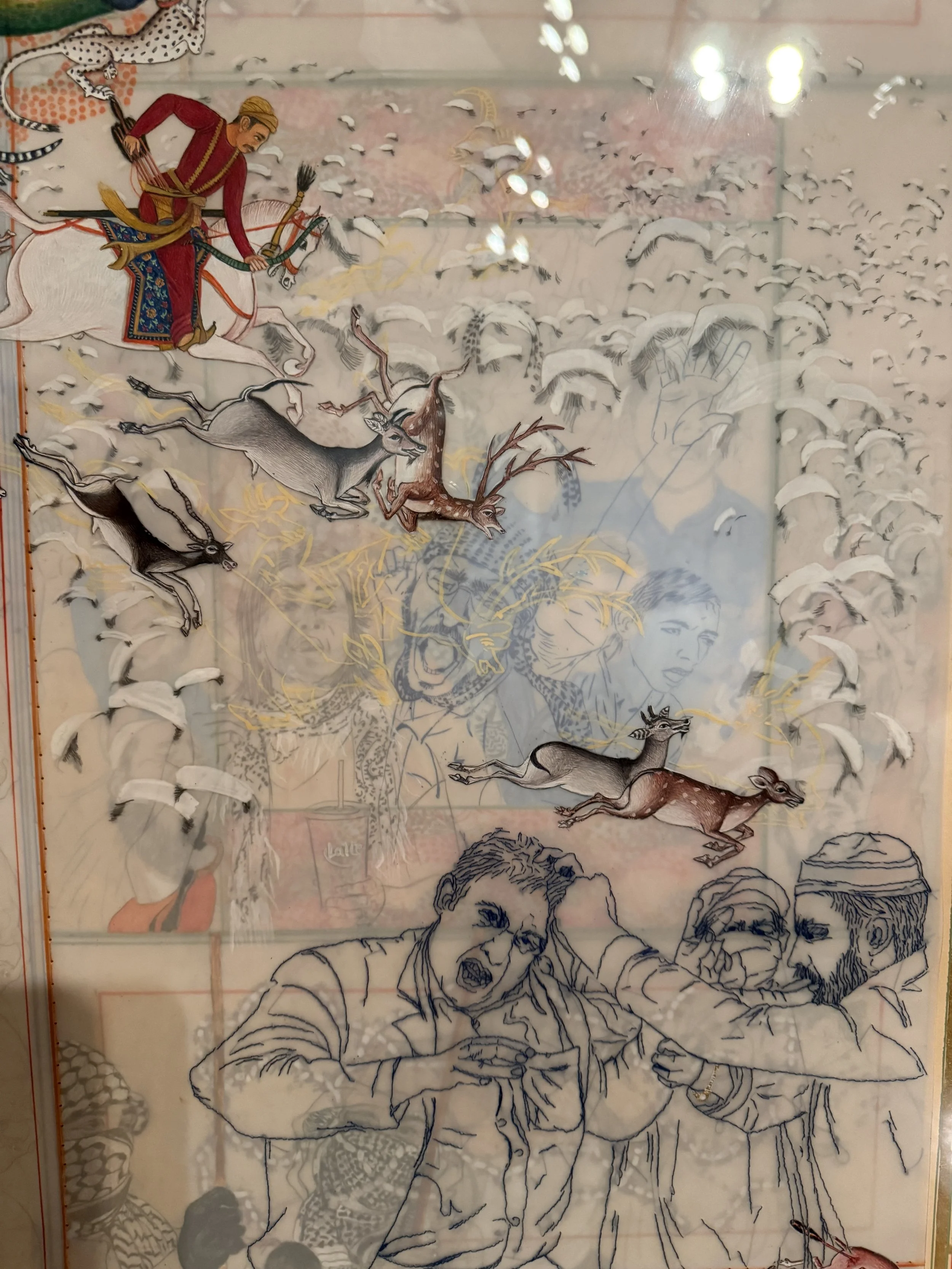
detail, Ambreen Butt, The Great Hunt from the series Dirty Pretty. Water-based pigments, whie gouche, thread and gold leaf on layers of mylar and tea-stained paper.
My own very first fiber art was quiltmaking, so it was fun to see very different works in that medium from Black quiltmakers. Carolyn Mazloomi’s “Nobody’s Free Until Everybody’s Free: Fannie Lou Hamer” recognizes in stark black and white the struggle and sacrifices of those in the Civil Rights Movement and before who paved the way for greater (still not complete) freedoms for Black Americans. Mazloomi says simply “Because of them, I am.”
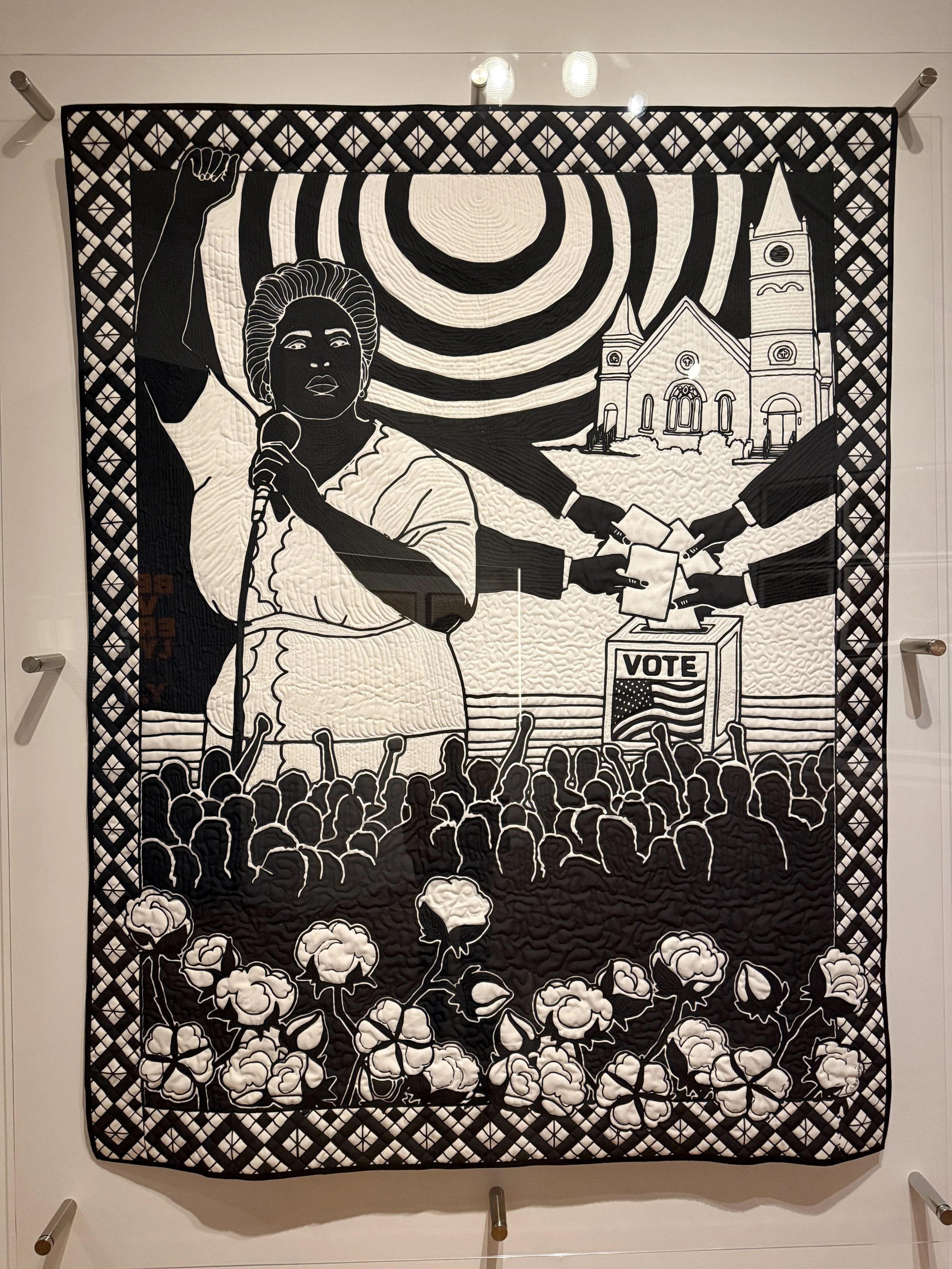
Carolyn Mazloomi, Nobody’s Free Until Everybody’s Free: Fannie Lou Hamer, cotton, fabric, thread and batting, fabric paint.
It’s always a treat to see the quilted work of a maker from Gee’s Bend, Alabama. Of all the pieces in the exhibit, this was one of my favorites. There is a pure joy evident in the colors and in the making that is not in the service of a larger, specifically didactic message. Closer study reveals that this quilt by Mary Lee Bendolph uses, as the Gee’s Been quilts do, repurposed clothing of the people in the community. Bendolph describes quilting as an act of love, faith and patience, resulting in something that “helps [one] go through life, understand life.”
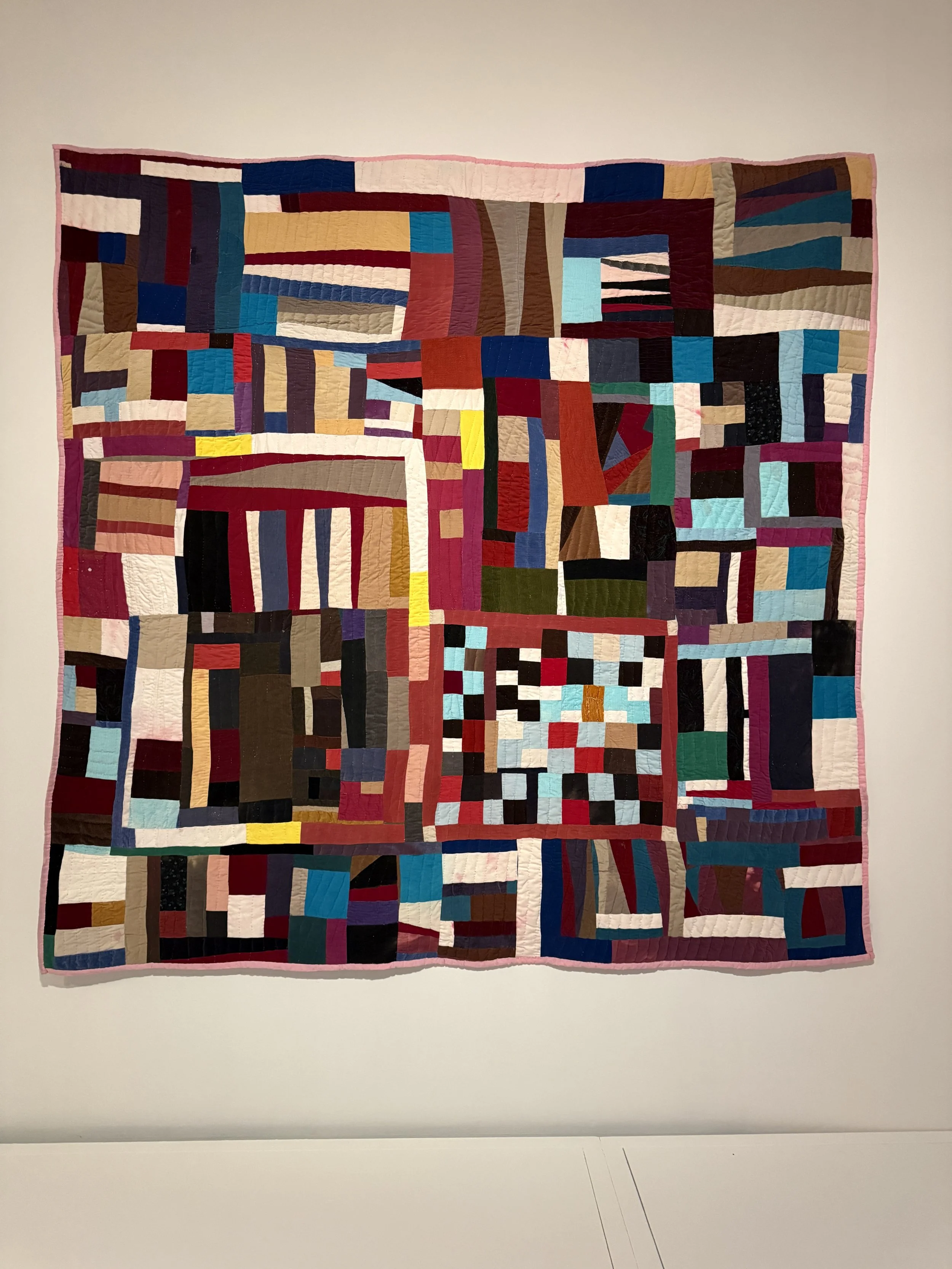
Mary Lee Bendolph, Blocked Out, cotton, corduroy, velvet, synthetic
Kathryn Clark uses the quilt medium to record the impact of inequalities resulting in abandoned properties in a given city. The comforting domestic blanket is inverted to become an uncomfortable document mapping a grid of foreclosed and vacant properties. The more foreclosures, the more fragile the community and the more raveled the fabric of the quilt. Like Bendolph, Clark says her quilts tell a story of community and the people whose lives are hidden in dry statistical data.
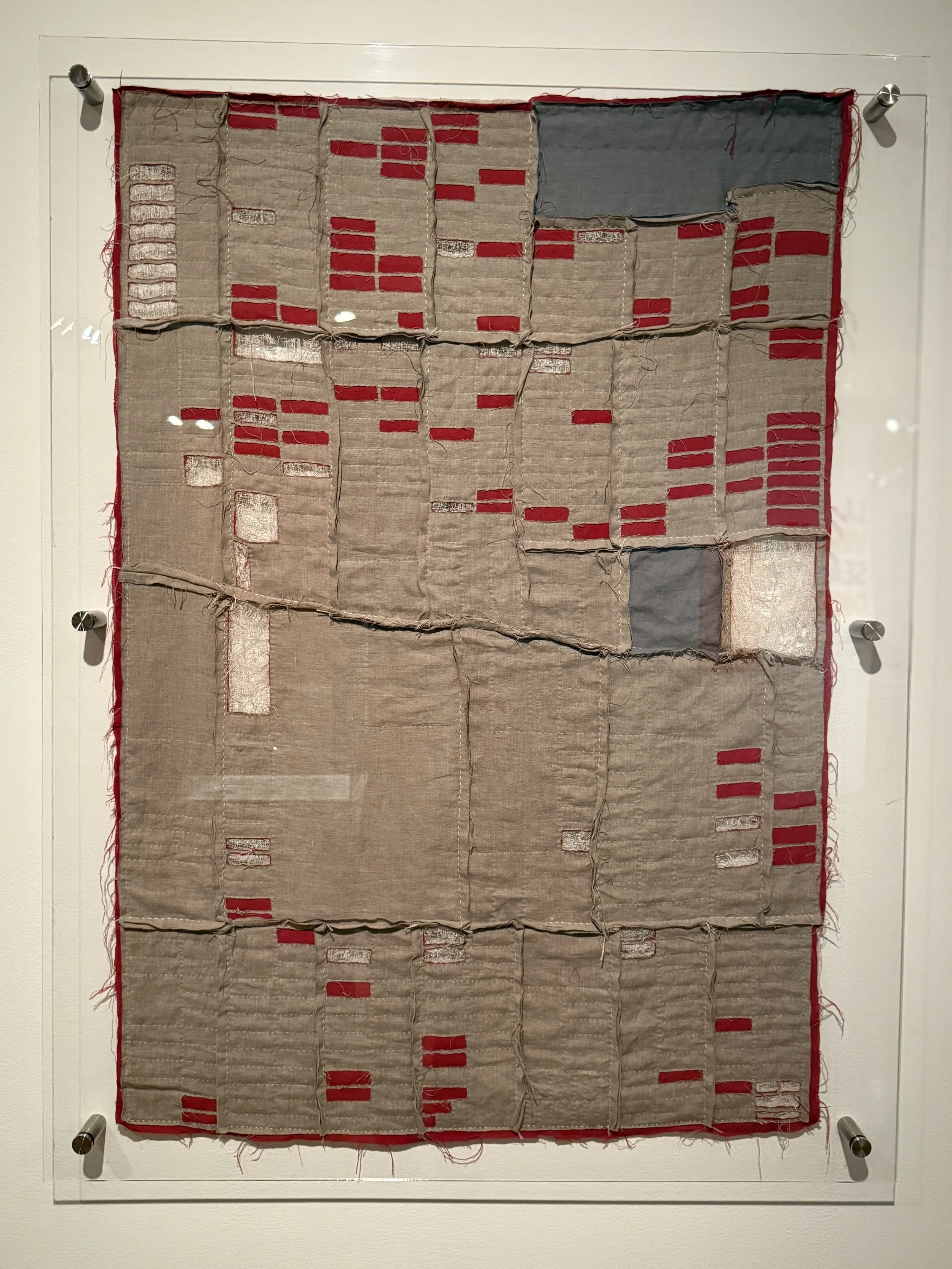
Kathryn Clark, Albuquerque Foreclosure Quilt (International District), linen, cotton, thread.
I was stopped in my tracks by the ceramics of Kukuli Velarde. Her series Plunder Me, Baby, evokes Pre-Columbian ceramics in subject matter and style. She imagines that her works are objects that have awoken from their slumber in ancient sites to find themselves, to their horror, as looted objects in a museum. Like Elyse Pignolet, the artist has turned a traditional form against itself to critique the circumstances of its traditional context. The depredations of colonizers nearly erased the indigenous populations and cultures that were here before the arrival of Europeans. The artist says, “‘They all have my face, for I had to become each of them to reclaim ownership and to take the name calling with defiance.’”
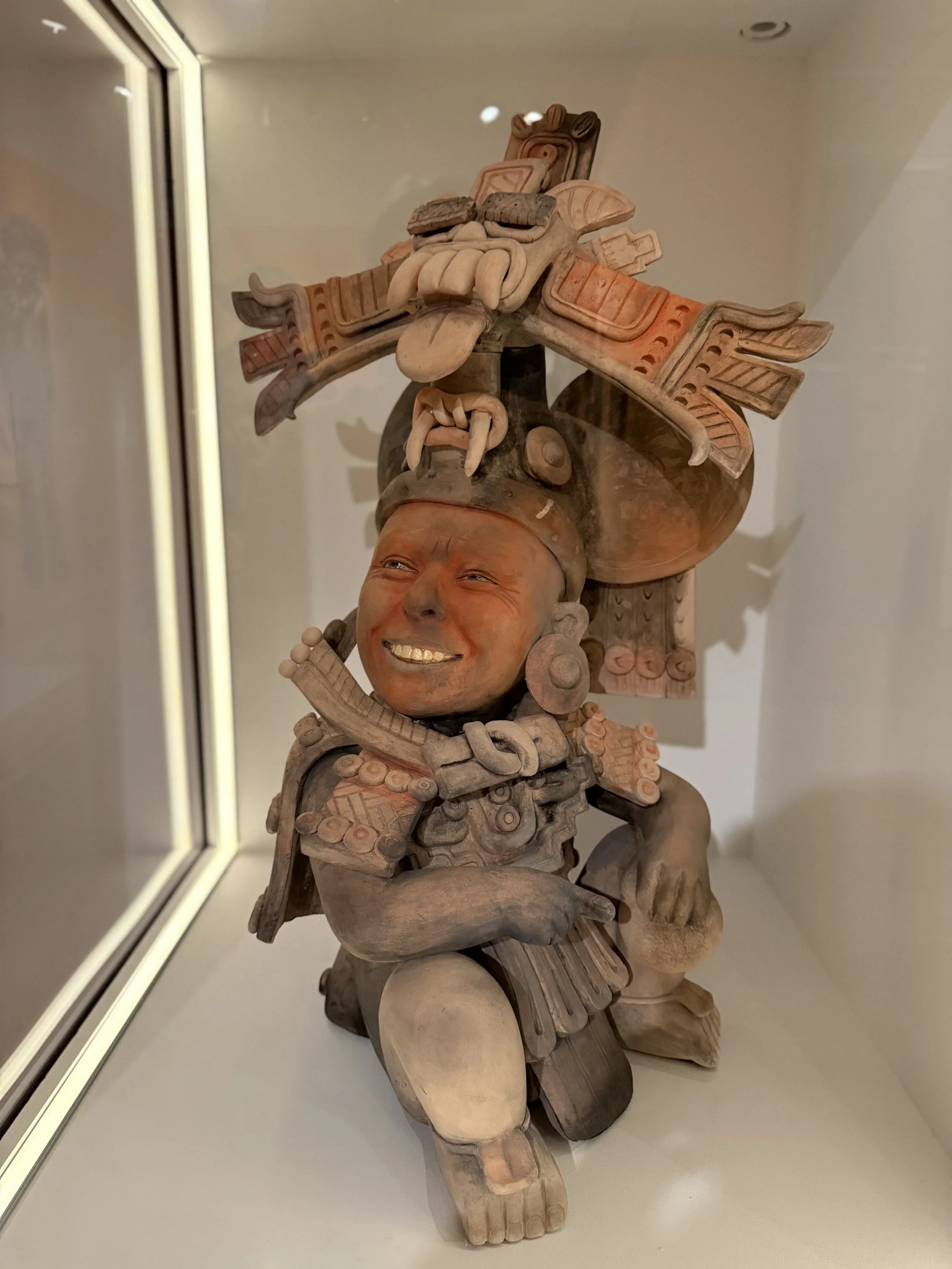
Kukuli Velarde, Jodida Indeja, De que se rie? Gotta be trained . . . what the f…! Zapoteca, Mexico, AD 300/700, from the series Plunder Me, Baby. Mocha clay, mixed media.
Nicholas Galanin’s two very different works in metal provoked a lot of thought for me. I noticed a pair of handcuffs, then looked again to check: Were they really that small? Were they meant for children? A native of Sitka, Alaska, Galanin displays a child-sized set of handcuffs alongside a beautifully carved silver bracelet featuring Tlingit motifs. The handcuffs reference the period in Native American history in both Canada and the US in which Native children were shipped off to boarding schools designed to strip them of their language, dress and culture in order to “fit” them for white society. In Alaska, it was Sheldon Jackson who carried out these policies which, as happened across the continent, often resulted in abuse, malnutrition and the deaths of thousands of children.
I was interested to learn from label text that this curatorial strategy of juxtaposing articles from contrasting contexts grew out of a Maryland Historical Society exhibit in 1992 called Mining the Museum. In that exhibit, fine silver objects belonging to the white elite were displayed alongside iron shackles used to restrain enslaved Black people.
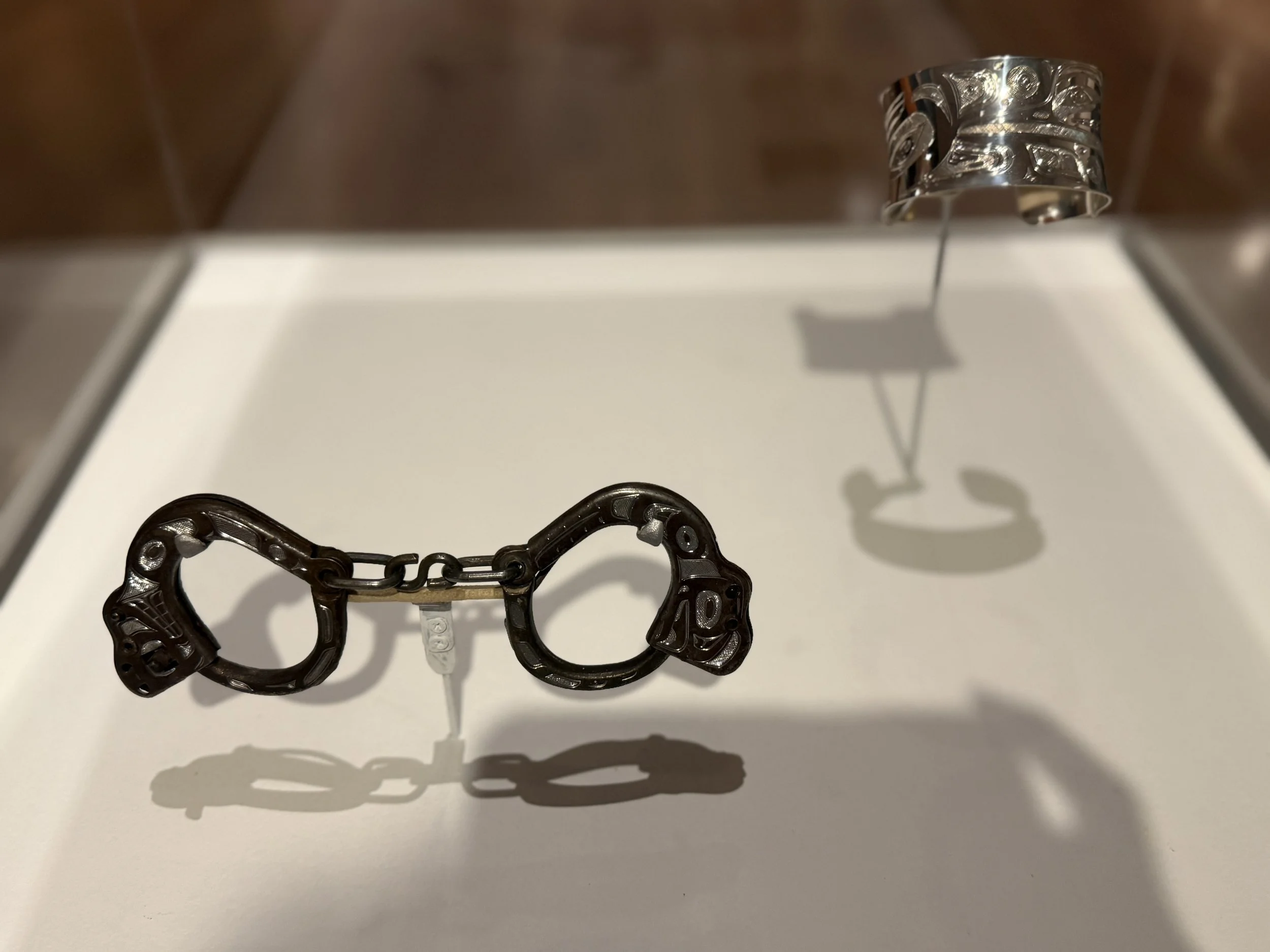
Nicholas Galanin, Language Removal Tools for Indian Children, Sheldon Jackson, hand-engraved iron; and Kéet (Killer Whale), hand-carved silver.
As this exhibit shows, there is a strong trend in the contemporary art world to foreground art work with explicit social-political agendas. God knows there is plenty wrong with our world today, and the roots of what is wrong lie in the past that objects like these powerfully bring to visual form. I do enjoy—if indeed enjoy is the right word—learning about the history and struggles of groups other than my own. My own education was woefully short on the history and experience of non-Europeans, and I am grateful for the chance to remedy that. For me, works like those of Pignolet, Butt, Velarde and Galanin masterfully balance aesthetic appeal with powerful concept. I love to see how a recognizable tradition or skill (a ceramic tradition or a tradition in manuscript illumination or fine silver work) can be turned inside out to critique a situation or call attention to past injustices whose effects persist today.
It is a fine line between using art as a means of critique and using it to preach or propagandize. I am educated and enlightened by this work, but I am not always transported by it. Perhaps the desire to be transported or uplifted is a luxury our times do not call for. Especially these days, I yearn for art whose beauty and fine workmanship goes some way toward restoring my faith in the creative potential of humankind. As I think about it, though, the work in this exhibit does, after all, display care, skill and gorgeous craftsmanship, and for that reason the messages conveyed are all the more powerful.
You can read Southwest Contemporary’s take on this exhibit here.